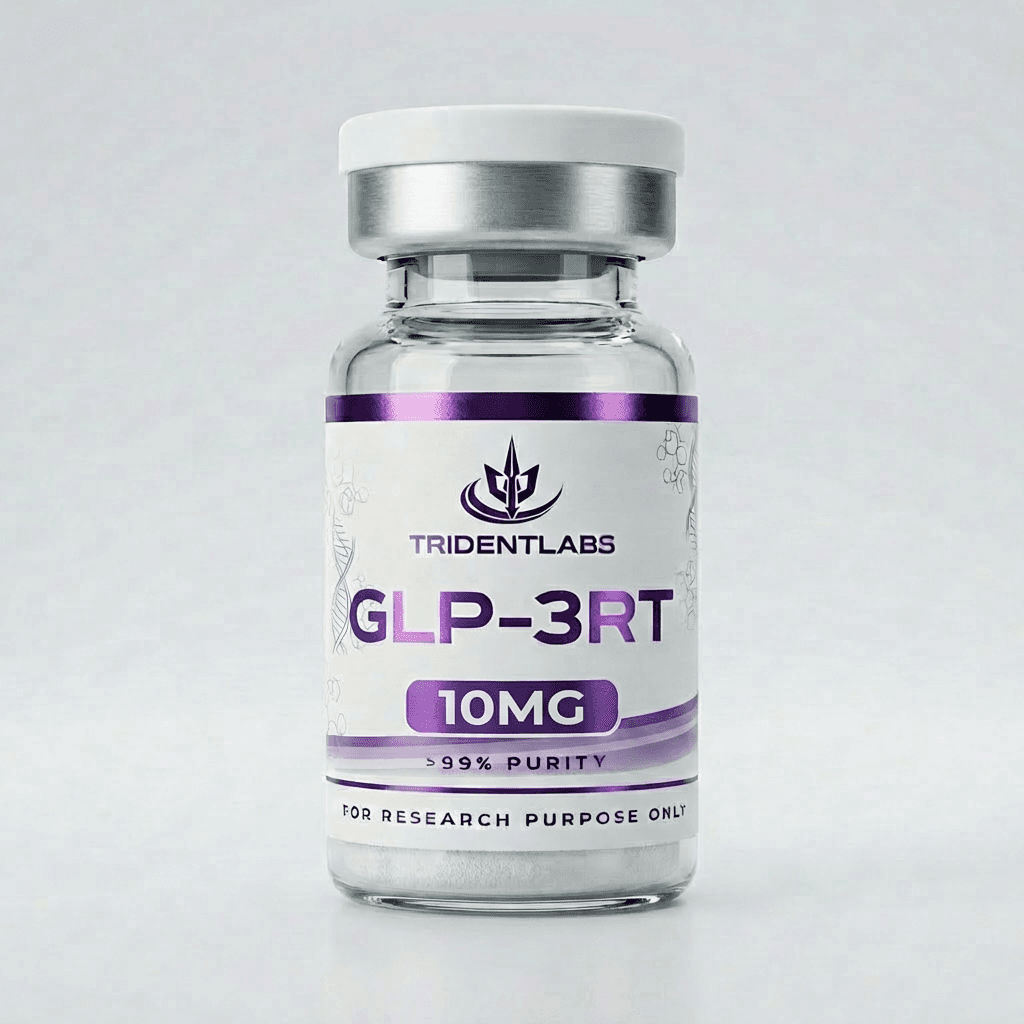
MOTS-c
10mg
A peptide your body already produces — encoded directly by mitochondrial DNA, not nuclear DNA, making it one of the most unique molecules in biology. Levels rise with exercise and fall with age. Research has studied its role in activating the same metabolic pathways as physical activity, including insulin sensitivity, fat metabolism, and cellular energy regulation.
Transparency
Certificate of Analysis
Every batch independently verified by third-party laboratories.
Batch #TL-6063329
MOTS-c Lab Certificates
All Trident Labs products are independently tested by accredited third-party laboratories. Results are batch-specific and provided for research transparency only. This product is not approved for human use.
Your cells already
make this peptide.
It declines with age.
A 16-amino acid peptide encoded by mitochondrial DNA — the first of its kind discovered to function as a signaling hormone. MOTS-c activates the same metabolic pathways as exercise, circulates in the bloodstream, and declines measurably with age. Studied across insulin sensitivity, body composition, bone biology, and longevity research.
Lee et al. Cell Metabolism 2015 · Kim et al. Nat Commun 2021 · Wan et al. J Transl Med 2023. All data from peer-reviewed literature. For Research Use Only — Not for Human Consumption.
Manufactured in US
US-formulated & filled
Endotoxin Tested
<0.05 EU/mL verified
Independently Tested
Horizon Analytical · 6-panel COA
Same Day Shipping
Order by 3PM PST
MOTS-c is supplied exclusively for qualified in vitro laboratory research. Not for human administration.
This product is a research-grade synthetic peptide supplied under research use only (RUO) designation. It is not approved by the FDA for any therapeutic indication. By purchasing, the buyer represents they are a qualified researcher using this compound solely for lawful in vitro laboratory research. Not a drug, dietary supplement, food, or medical device. For Research Use Only — Not for Human Consumption.
Born in
the mito-
chondria.
MOTS-c is unlike any other peptide in the research catalogue. While virtually all peptides are encoded by nuclear DNA, MOTS-c is encoded within mitochondrial DNA — specifically within a region of the 12S rRNA gene not previously known to produce proteins. This makes it the first mitochondrial-derived peptide (MDP) confirmed to function as a systemic hormone.
From Mitochondria to Nucleus
Nuclear DNA
Encodes ~20,000 proteins — the source of virtually all other peptides
Mitochondrial DNA
Encodes MOTS-c within the 12S rRNA region — unique origin
12S rRNA → mRNA
exported → Cytoplasm
translation → MOTS-c
peptide
Sequence: MRWQEMGYIFYPRKLR
16
Amino acids
14
Species conserved
2015
Discovered
Lee et al. Cell Metabolism 2015;21:443–454. PMID: 25738459
Levels
fall as
you age.
MOTS-c is not just a peptide your body makes — it's one that declines measurably with age. Both circulating plasma levels and skeletal muscle expression show age-dependent reduction in both human cross-sectional studies and rodent models. This decline tracks closely with the deterioration of mitochondrial function seen in aging.
Kim et al. Nat Commun 2021 · PMID 31530505 · Wan et al. J Transl Med 2023
MOTS-c Level Across Life — Relative to Young Baseline
Schematic based on Kim et al. 2021 & human cross-sectional data. For research illustration — research use only.
The Folate–AICAR–
AMPK pathway.
MOTS-c activates AMPK through an indirect but precise mechanism — not by depleting ATP (the standard energy stress signal), but by targeting the folate cycle and purine synthesis pathway. This allows MOTS-c to engage AMPK-dependent metabolic programming even under nutrient-replete conditions.
Folate Cycle Inhibition → AICAR Accumulation
MOTS-c inhibits the folate cycle and de novo purine synthesis pathway in the cytoplasm. This causes AICAR (5-aminoimidazole-4-carboxamide ribonucleotide) to accumulate — the same metabolite used by the research tool compound AICA riboside to pharmacologically study AMPK. MOTS-c is effectively generating endogenous AICAR without cellular energy depletion.
AICAR → AMPK → Metabolic Reprogramming
AICAR potently activates AMPK — the master regulator of cellular metabolism. MOTS-c-mediated AMPK activation then drives: enhanced GLUT4 translocation (glucose uptake), increased fatty acid oxidation, improved mitochondrial biogenesis, and insulin sensitization. These downstream effects are measurable by standard metabolic assay panels.
Stress → Nuclear Translocation → Gene Regulation
Under metabolic stress (glucose restriction, oxidative stress, serum deprivation), MOTS-c translocates to the nucleus within 30 minutes — in an AMPK-dependent manner. Inside the nucleus, it binds antioxidant response elements (ARE) and modulates the expression of stress adaptation genes. A positive feedback loop: AMPK promotes nuclear translocation, which amplifies AMPK-mediated effects.
Endocrine Signaling — Cross-Tissue Communication
MOTS-c is released into circulation and acts as a "mitokine" — a hormone produced by mitochondria to signal metabolic state to distant tissues. Expressed highest in tissues with high mitochondrial content: skeletal muscle, brain, liver, kidney. Exercise acutely increases circulating MOTS-c levels, suggesting it mediates some of exercise's systemic metabolic benefits.
AMPK Pathway — Step by Step
Entry Point
MOTS-c → Cytoplasm
Translated from exported mtRNA. Localizes to cytoplasm at rest. Declines with age and poor metabolic health.
↓Step 1
Folate Cycle Inhibition
Blocks de novo purine biosynthesis → AICAR accumulates. No ATP depletion required — mechanistically distinct from energetic stress.
↓Key Step
AICAR → AMPK Activation
Endogenous AICAR activates AMPK. Same pathway as AICA riboside (pharmacological AMPK tool). Forms positive feedback with nuclear MOTS-c.
↓Step 3
AMPK Downstream Effects
GLUT4 translocation · fatty acid oxidation · mitochondrial biogenesis · insulin sensitization · inflammation suppression · SIRT1 activation.
↓Parallel
Nuclear Translocation (Stress-Induced)
AMPK-dependent nuclear entry within 30 min of metabolic stress. Binds ARE sites → stress adaptation gene expression. Returns to cytoplasm within 24h.
Lee et al. Cell Metabolism 2015 · Kim et al. Nat Commun 2021 · Wan et al. J Transl Med 2023
The peptide that
mimics a workout.
MOTS-c rises acutely with physical exercise in both rodent models and human studies — and when administered exogenously, it activates many of the same cellular pathways that exercise engages. This has led researchers to classify MOTS-c as an "exercise mimetic" — a compound that replicates metabolic aspects of physical training at the molecular level.
Kim et al. (Nature Communications 2021) demonstrated that MOTS-c expression is exercise-inducible in skeletal muscle, declines with aging, and that exogenous administration reverses age-dependent physical decline in mice — restoring exercise capacity, muscle homeostasis, and metabolic function in aged animals.
Shared Pathway Activation
Six active research
domains.
Insulin Resistance & Glucose Metabolism
Lee et al. 2015: MOTS-c reversed diet-induced and age-induced insulin resistance in mice. Improved GLUT4 translocation and glucose uptake in skeletal muscle. OGTT, glucose clamp, and GLUT4 immunofluorescence are standard assay endpoints.
Aging & Longevity Biology
Declining MOTS-c is a biomarker of mitochondrial aging. Exogenous treatment restored age-related physical decline in old mice (Kim et al. 2021). Lifespan, frailty, and muscle homeostasis are documented research endpoints in aged animal models.
Bone & Osteoporosis
MOTS-c suppresses ovariectomy-induced osteoporosis via AMPK activation (Ming et al. 2016). Also studied via the TGF-β/Smad pathway (Hu and Chen 2018). BMD, osteoblast/osteoclast balance, and bone formation markers are measurable endpoints.
Obesity & Body Composition
Systemic MOTS-c treatment reversed diet-induced obesity in mice (Lee et al. 2015) — reducing fat accumulation, increasing energy expenditure, and decreasing fatty liver. Fat mass, lean mass, energy expenditure by indirect calorimetry are standard endpoints.
Cardiovascular Research
MOTS-c protects against cardiac ischemia-reperfusion injury in rodent models via AMPK-mediated cardioprotection. Myocardial infarct size, cardiac function (echocardiography), and cardiomyocyte apoptosis are documented research endpoints.
Inflammation & Immune Modulation
MOTS-c modulates NF-κB signaling and inflammatory cytokine profiles. Studied in sepsis models, inflammatory bowel disease contexts, and age-related chronic inflammation (inflammaging). IL-6, TNF-α, NF-κB reporter assays are standard readouts.
All research endpoints from peer-reviewed literature. Preclinical data — research use only. Not Trident Labs claims.
Full specification.
Molecular and analytical data from peer-reviewed literature and Trident Labs batch records.
Long-term
-20°C
Lyophilized sealed. Stable 24 months. Desiccated. Avoid frost-free freezers.
In solution
4°C
Stable 7 days. Single-use aliquots. Carrier protein (0.1% BSA) recommended for long-term.
Solvent
H2O
Reconstitute in sterile water ≥100 μg/mL. Further dilute in aqueous buffer.
Avoid
Freeze-thaw
Prevent repeated freeze-thaw cycles. Aliquot immediately after reconstitution.
For Research Use Only — Not for Human Consumption. MOTS-c supplied exclusively for in vitro laboratory research. Not a drug, dietary supplement, or medical device. For lawful in vitro research use only by qualified researchers.
| Common Name | MOTS-c / Mitochondrial ORF of the 12S rRNA-c |
| Sequence | MRWQEMGYIFYPRKLR |
| CAS Number | 1627580-64-6 |
| Molecular Formula | C101H152N28O22S2 |
| Molecular Weight | 2,174.6 Da |
| Encoding | Mitochondrial DNA — 12S rRNA short open reading frame |
| Mechanism | Folate cycle inhibition → AICAR → AMPK → nuclear translocation under stress |
| Primary Targets | AMPK, SIRT1, NF-κB, antioxidant response elements (ARE) |
| Primary Tissues | Skeletal muscle, brain, liver, kidney — high mitochondrial content |
| Age Relationship | Plasma and muscle levels decline significantly with chronological aging |
| Exercise Induction | Acutely elevated by physical exercise; dubbed "exercise mimetic" |
| Species Conservation | First 11 residues conserved across 14 species including humans and mice |
| Form | Lyophilized powder · sealed glass vial |
| Purity | ≥99% HPLC · Mass Spec verified · 6-panel COA · Horizon Analytical |
| Endotoxin | <0.05 EU/mL · LAL-tested · Horizon Analytical |
| Regulatory | RUOIn Vitro Research Use Only — Not for Human Consumption |
Indexed research on MOTS-c.
Independent peer-reviewed studies. Not Trident Labs claims. For Research Use Only.
The Mitochondrial-Derived Peptide MOTS-c Promotes Metabolic Homeostasis and Reduces Obesity and Insulin Resistance
Lee C, Zeng J, Drew BG, Sallam T, et al.
The foundational 2015 paper discovering and characterizing MOTS-c. Identified the 16-amino acid sORF within mitochondrial 12S rRNA. Demonstrated that MOTS-c promotes metabolic homeostasis via the folate cycle and AICAR/AMPK pathway in skeletal muscle. Systemic MOTS-c treatment reversed diet-induced obesity and diet- and age-dependent insulin resistance in mice. Improved glucose uptake and insulin sensitization. Established MOTS-c as a novel mitochondrial-encoded peptide hormone. Cell Metab 2015;21(3):443–454. PMID: 25738459.
MOTS-c is an Exercise-Induced Mitochondrial-Encoded Regulator of Age-Dependent Physical Decline and Muscle Homeostasis
Kim KH, Benayoun BA, Bharat D, et al.
Established MOTS-c as an exercise-inducible peptide that declines with age. MOTS-c levels rise acutely in skeletal muscle with physical exercise; decline with chronological aging in both rodent models and human cross-sectional data. Exogenous MOTS-c administration in old mice reversed age-dependent physical decline — restoring running capacity, muscle homeostasis, and metabolic gene expression to patterns resembling younger animals. Confirms MOTS-c as a mitokine mediating exercise's systemic metabolic benefits. Nat Commun 2021;12:1544. PMID: 33686077.
Mitochondria-Derived Peptide MOTS-c: Effects and Mechanisms Related to Stress, Metabolism and Aging
Wan W, Zhang L, Lin Y, et al.
Comprehensive 2023 review covering MOTS-c's retrograde signaling, folate-AICAR-AMPK mechanism, nuclear translocation dynamics, and applications across aging, metabolic disease, cardiovascular protection, and inflammation. Reviews all major published research to 2023. Covers AMPK-dependent nuclear translocation within 30 min of metabolic stress, ARE-mediated gene regulation, SIRT1 activation, and the positive feedback loop between AMPK and nuclear MOTS-c. Discusses therapeutic potential and the challenge of clinical translation. J Transl Med 2023;21:29.
MOTS-c: A Promising Mitochondrial-Derived Peptide for Therapeutic Exploitation
Frontiers Endocrinology Research Group.
Review covering MOTS-c discovery, mitochondrial encoding mechanism, cytoplasmic translation, conservation across 14 species, and applications against disease. Details endocrine-like and nuclear transcriptional regulation on muscle metabolism, insulin sensitivity, and body weight. Discusses the challenge of receptor identification (no cellular receptor confirmed to date), and covers all six major research endpoint areas: insulin resistance, obesity, bone, cardiovascular, inflammation, and aging. Front Endocrinol 2023;14:1120533. PMC9905433.
The Mitochondrial-Derived Peptide MOTS-c is a Regulator of Plasma Metabolites and Enhances Insulin Sensitivity
Kim SJ, Xiao J, Wan J, et al.
Metabolomics study characterizing MOTS-c's effects on plasma metabolite profiles. MOTS-c increased glucose utilization and fatty acid oxidation, decreased oxidative phosphorylation, increased endogenous AICAR, and activated AMPK. Improved insulin sensitivity in old mice by increasing glucose uptake in muscle. Administration in high-fat diet-fed mice decreased weight gain, increased energy expenditure, and significantly decreased fatty liver. Provides comprehensive metabolic phenotyping of MOTS-c action. Physiol Rep 2019;7(14):e14171.
Small Peptides: Could They Have a Big Role in Metabolism and the Response to Exercise?
Atakan MM, et al.
2024 comprehensive review of mitochondrial-derived peptides and their role in exercise physiology. Features MOTS-c prominently as an exercise-induced MDP. Covers MOTS-c's role in skeletal muscle metabolism (AMPK, Akt, SIRT1 interactions), insulin sensitivity, mitochondrial homeostasis, and adaptive stress responses. Discusses 130+ published MOTS-c research articles indexed by 2023. Reviews evidence for MOTS-c as a key mediator of exercise's systemic metabolic benefits and its research potential in metabolic flexibility, aging biology, and longevity. J Physiol 2024. PMID indexed.
Independent peer-reviewed research — not Trident Labs claims. MOTS-c supplied for in vitro research use only. Not for human consumption.
References
Lee C, Zeng J, Drew BG, Sallam T, et al.
The mitochondrial-derived peptide MOTS-c promotes metabolic homeostasis and reduces obesity and insulin resistance
Kim KH, Benayoun BA, Bharat D, et al.
MOTS-c is an exercise-induced mitochondrial-encoded regulator of age-dependent physical decline and muscle homeostasis
Wan W, Zhang L, Lin Y, et al.
Mitochondria-derived peptide MOTS-c: effects and mechanisms related to stress, metabolism and aging
Frontiers Endocrinology Research Group.
MOTS-c: A promising mitochondrial-derived peptide for therapeutic exploitation
Kim SJ, Xiao J, Wan J, et al.
The mitochondrial-derived peptide MOTS-c is a regulator of plasma metabolites and enhances insulin sensitivity
Atakan MM, et al.
Small peptides: could they have a big role in metabolism and the response to exercise?
Support
Frequently Asked Questions
Everything you need to know about this product and your order.